by Dr. Jaydeep T. Vagh
In mathematics, the Zak transformis a certain operation which takes as input a function of one variable and produces as output a function of two variables. The output function is called the Zak transform of the input function. The transform is defined as an infinite series in which each term is a product of a dilation of a translation by an integer of the function and an exponential function. In applications of Zak transform to signal processing the input function represents a signal and the transform will be a mixed time–frequency representation of the signal. The signal may be real valued or complex-valued, defined on a continuous set (for example, the real numbers) or a discrete set (for example, the integers or a finite subset of integers). The Zak transform is a generalization of the discrete Fourier transform.
The Zak transform had been discovered by several people in different fields and was called by different names. It was called the “Gel’fand mapping” because I.M. Gel’fand introduced it in his work on eigenfunction expansions. The transform was rediscovered independently by Joshua Zak in 1967 who called it the “k-q representation”. There seems to be a general consent among experts in the field to call it the Zak transform, since Zak was the first to systematically study that transform in a more general setting and recognize its usefulness
Continuous-time Zak transform: Definition
n defining the continuous-time Zak transform, the input function is a function of a real variable. So, let f(t) be a function of a real variable t. The continuous-time Zak transform of f(t) is a function of two real variables one of which is t. The other variable may be denoted by w. The continuous-time Zak transform has been defined variously.
Definition 1
Let a be a positive constant. The Zak transform of f(t), denoted by Za[f], is a function of t and w defined by

Definition 2
The special case of Definition 1 obtained by taking a = 1 is sometimes taken as the definition of the Zak transform.[2] In this special case, the Zak transform of f(t) is denoted by Z[f].

Definition 3
The notation Z[f] is used to denote another form of the Zak transform. In this form, the Zak transform of f(t) is defined as follows:
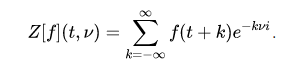
Definition 4
Let T be a positive constant. The Zak transform of f(t), denoted by ZT[f], is a function of t and w defined by

Here t and w are assumed to satisfy the conditions 0 ≤ t ≤ T and 0 ≤ w ≤ 1/T.
Properties of the Zak transform
In the following it will be assumed that the Zak transform is as given in Definition 2.

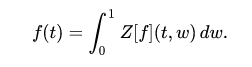
Inversion formula
Given the Zak transform of a function, the function can be reconstructed using the following formula:
Discrete Zak transform: Definition
n defining the discrete Zak transform, the input function is a function of an integer variable. So, let f(n) be a function of an integer variable n (n taking all positive, zero and negative integers as values). The discrete Zak transform of f(n) is a function of two real variables one of which is the integer variable n. The other variable is a real variable which may be denoted by w. The discrete Zak transform has also been defined variously. However, only one of the definitions is given below.
Definition
The discrete Zak transform of the function f(n) where n is an integer variable, denoted by Z[f], is defined by

Inversion formula
Given the discrete transform of a function f(n), the function can be reconstructed using the following formula:

Applications
The Zak transform has been successfully used in physics in quantum field theory, in electrical engineering in time-frequency representation of signals, and in digital data transmission. The Zak transform has also applications in mathematics. For example, it has been used in the Gabor representation problem.
 ravanTech